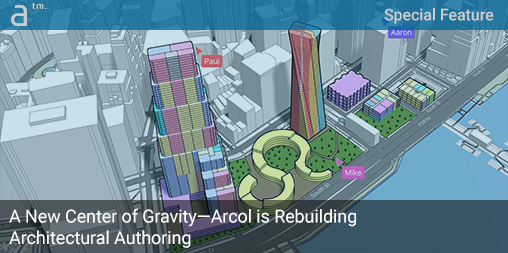
WHEN ARCOL DEBUTED AT THE AIA NATIONAL CONVENTION in Boston last June—winning Architosh’s BEST of SHOW award in the BIM category—it was easy to mistake it for yet another fast, pretty, cloud-based modeling tool. But architects who stopped to actually see how the BIM 2.0 tool functioned discovered that Arcol was more than just an early-stage design helper for fast feasibility studies.
If you ask founder and CEO Paul O’Carroll what kind of product Arcol is, he doesn’t start with “feasibility,” “mass modeling,” or even “BIM.”
MORE: Arcol Makes Big Splash at AIA National Boston
“Arcol is not a feasibility tool,” he says. “I didn’t set out to create a feasibility tool for our industry. I wanted to rethink all of authoring in our industry, with the browser, with collaboration, and, increasingly more importantly, with AI at its core.”
Early design became Arcol’s starting point, not because it was the company’s focus, but because it is where the industry feels most pain. It is, O’Carroll says, “a mess,” a stage where most firms stitch together SketchUp, InDesign, Excel, and Miro to assemble presentations to owners. BIM tools were never built to handle this phase gracefully. Autodesk’s acquisition of Spacemaker, which evolved into Forma, is one acknowledgment of that gap.
I didn’t set out to create a feasibility tool for our industry. I wanted to rethink all of authoring in our industry, with the browser, with collaboration, and, increasingly more importantly, with AI at its core.
Arcol aims to collapse that fragmentation into a single, fluid environment where concept modeling, layout, costing, and collaboration coexist from the moment a design idea is born. For architects using Arcol, early-phase modeling isn’t something done in isolation and exported later. It becomes the foundation for everything that follows.
Arcol’s long-term ambition is expansive, but its entry point is deliberately narrow: owning the earliest decisions in a project, before documentation, before detailing, before traditional BIM tools are at their strongest. And this is not just about the design team, but rather every player, from owners, architects, engineers, and the general contractor.
Rethinking the Design Phase—Not Just Dressing It Up
O’Carroll is very clear that Arcol’s entry point—early-stage design—is strategic, not limiting.
On one level, this is about going where incumbent BIM tools are weakest. Revit, he notes, is “a big, scary product” with enormous surface area and legacy. It dominates documentation and production, but it’s notoriously clumsy in the conceptual phase.
“The way we think about our product strategy,” he says, “is to effectively and discreetly attack the design stages.”
Today, that means owning the earliest phase—concept, options, and feasibility studies—as a fully cloud-based, real-time multi-user BIM environment.

A view of Arcol’s hybrid 2D and 3D user-interface interlaced with planning data that updates in real time to modeling and design configuration changes.
Owners respond positively to this transparency. Instead of seeing a frozen design snapshot, they see the thinking and the possibilities behind it. And because Arcol updates instantly as the model changes, cost implications, area take-offs, and diagrammatic relationships all move with it in real time. This ability to treat the early design phase as a true BIM space—data-driven, collaborative, and representational—sets the foundation for the platform’s broader ambitions.
Boards: Rethinking the Pin-Up Wall
One of Arcol’s most distinctive features is Boards, an infinite 2D canvas that blends model views, diagrams, images, annotations, and layout into one freeform presentation environment. O’Carroll says the idea came from watching firms adopt Miro and other whiteboarding tools to replace the studio pin-up wall. When the company wrote its early manifesto, it included the notion that architects needed a digital space that combined “Miro plus InDesign,” allowing creative composition rather than rigid sheet construction.

Boards are a critical feature in Arcol and marry aspects of Miro and Adobe InDesign. They are useful for multiple functions, from pin-up reviews, inspo boards, and team and client meetings, among other things. They are also part of its long-term strategic planning to take on documentation.
Boards function as both an ideation surface and a presentation environment. They allow designers to work the way they sketch and think—freely, visually, and without the constraints of margins or pagination. But Boards also reflect Arcol’s long-term view of documentation. O’Carroll notes that as AI automates more aspects of documentation, architects will still need a creative 2D space to arrange, communicate, and curate the story of a project. Boards are designed as that future-proof layer. They solve today’s layout needs while preparing for an era where documentation becomes more automated, and presentation becomes more emergent.
Rhino and the Quest for a Unified Authoring Tool
The early-phase space is important to Arcol, but O’Carroll’s long-term goal is to build a next-generation authoring tool that handles both experimental geometry and production documentation. He is blunt about the limitations of current workflows. Revit, he notes, is not just poor at advanced geometry—it is “not a good design tool in general.” Rhino, meanwhile, is beloved for its geometric power yet “not a building design tool” and not inherently BIM. It emerged from boat modeling and remains a freeform NURBS environment, not a structured architectural one.

Arcol has developed its own proprietary geometry engine purpose-built for AEC and the needs of architects. This gives Arcol control and development speed over rivals. At the same time, Arcol is developing a Rhino integration coming soon.
Arcol wants to merge the strengths of both worlds. When O’Carroll describes the future of authoring, he argues that “you should be able to do the crazy, curvy architecture and the documentation in the same tool.” This is why Arcol is investing so heavily in a geometry engine capable of “complex buildings”—twisting towers, leaning slabs, and curved envelopes that are not just shapes but data-bearing elements that support floor cuts, schedules, and quantities.
Arcol is not building a mesh modeler. It is building a BIM-first geometry engine that can handle complex, expressive forms in a structured way.
Deep Rhino Integration: A Bridge to the Future
For now, Arcol is aiming to pair that ambition with a deep Rhino integration designed to allow firms to keep using Rhino while gradually shifting BIM tasks into Arcol. This is more than a file importer. O’Carroll describes the goal as enabling designers to model in Rhino, send geometry directly to Arcol, cut floors and extract data, then push changes back to Rhino and have Arcol update automatically. He contrasts this with solutions like RhinoInside, which he says can feel clunky and incomplete.
Arcol’s approach positions Rhino as an advanced geometry companion rather than a separate design silo. Rhino handles the most complex shapes, and Arcol handles the BIM, the cuts, the data, the sheets, and eventually more advanced geometry itself. This bridge allows Arcol to focus on the design-development and documentation domains currently dominated by Revit. And because Arcol treats Rhino geometry as native, it dissolves the typical boundary between concept modeling and BIM authoring.

Rhino integration with Arcol further cements Rhino’s reputation as the dominant 3D modeler for advanced form-making in architecture while delivering the critical data layer and data analytics that power Arcol’s strengths in early design and test-fitting type workflows.
O’Carroll sees this as essential to Arcol’s long-term goal. When asked whether he means to displace Revit only in the design stages, he is direct: “In the future, with Arcol, you shouldn’t have to ever use Revit.” This is not a timid ambition. It is a strategic direction.
Forma and the Incumbent Cannibalization Trap
Autodesk’s Forma validates Arcol’s direction, but O’Carroll sees Forma’s challenge as one not of creativity but of cannibalization. Revit remains Autodesk’s core revenue anchor. Forma must innovate enough to compete with startups like Arcol, but not so much that it undermines the mothership. O’Carroll says this forces Autodesk to “walk a very slow, precise line” that startups do not have to respect.
He also believes that Forma has been following, not leading. He notes that Forma has repeatedly copied Arcol’s features, calling this “validation” of Arcol’s direction. And because Forma is bundled with Autodesk subscriptions, many customers have access to it for free but still choose Arcol for its speed, immediacy, and collaborative depth. The implication is that Forma cannot move as fast as it needs to, and its strategy is constrained by a business model built around per-seat licensing in an era barreling toward automation.
While Autodesk talks about fixing industry data to unlock AI, O’Carroll argues the deeper issue is that legacy BIM platforms were architected before LLMs or agentic workflows existed. Their challenge is to rewrite decades-old file structures; Arcol’s advantage is simply that it doesn’t have that burden.
AI Agents and the Future of Model-Centric Collaboration
One thing that Autodesk Forma does have is an expanding ecosystem of apps and connections to Forma. Yet, O’Carroll feels this is far less important than the core problems that remain unsolved. “Our strategy is on users’ problems, not building out an ecosystem,” he says.
One of the biggest core problems facing the industry has always been collaboration, and Arcol, from the beginning, has taken an approach that stemmed from Figma’s groundbreaking collaborative approach.

Arcol firmly believes that agentic AI will power Arcol along with human architects in the near future as just another type of “collaborator” in the design process.
“Figma was really the first company that did this. That company’s CEO is one of our early investors, and we have been really fortunate to hire a lot of Figma engineers, and this is an important part of the DNA of our company,” says O’Carroll.
Connected to that DNA about collaboration is the role AI may play. If Arcol’s collaborative engine comes from its Figma DNA, its AI strategy follows naturally from the idea that the model should host not just humans but agents. O’Carroll believes that within a few years, “there will be more AI agents in our industry than individuals,” he says, and that these agents “will behave not as separate tools but as collaborators” occupying the same design environment as architects, engineers, and builders.
Figma was really the first company that did this. That company’s CEO is one of our early investors, and we have been really fortunate to hire a lot of Figma engineers, and this is an important part of the DNA of our company.
In this future, a general contractor might provide not a human preconstruction service but a preconstruction agent that joins an Arcol file to run cost, risk, or schedule assessments. Because Arcol’s environment is real-time and multi-user, agents can coexist with human designers and provide feedback instantly. O’Carroll says this agentic future amplifies Arcol’s collaborative advantage: “Agents are just collaborators,” and Arcol aims to be the best collaborative workspace in the industry.
This philosophy drives Arcol’s insistence on a browser-native, multi-cursor system. Collaboration is not a feature—it is a foundation enabling a future where teams and agents share a single model space, responding to changes as they happen.
GCs and Owners: Rise of Preconstruction-Driven Design
Perhaps the most disruptive change Arcol is accelerating lies not in geometry but in cost. Across the US, large general contractors are moving upstream into design, using their vast Procore project histories to guide owners earlier and with more accuracy than ever before. Many are acquiring architecture firms or building in-house design teams.
Arcol sits at the center of this shift because its conceptual cost engine runs directly off the design model. As a team pushes and pulls geometry, Arcol updates quantities, assumptions, and cost implications instantly. And unlike traditional conceptual estimating, Arcol does not require detailed modeling of components. Instead, it uses user-defined rules—such as structure type or stud spacing—to “infer costs” from high-level geometry. Inferring will only take costs so far, but in the early stage, this level of information can be impactful.

Arcol’s early-stage building costing functions leverage “user-defined” rules to infer costs from high-level geometry rather than itemize every building element, since such data does not exist in early-phase architectural work. This enables architects to see cost impacts from various design options early.
This enables a form of real-time value engineering. O’Carroll describes GCs who load their historical Procore data into Arcol to compare a new design against dozens of similar past projects. The confidence this gives owners is transformative. They see cost implications unfold as the design evolves rather than weeks later during bidding.
Arcol is not trying to replace detailed estimating, but it wants to own the early conceptual cost space—the part of the design process where architects frequently struggle to keep budgets aligned with design ambition. O’Carroll acknowledges that architects often let cost control drift downstream, only to be surprised by budget overruns. He imagines a more collaborative approach where architects send GCs an Arcol link and work together live, clarifying where design intent and cost flexibility intersect.
In this scenario, Arcol becomes the shared language of early decision-making. Owners, architects, and builders see the same model, the same numbers, and the same assumptions. And because the model drives the cost, trust grows. This transparency marks a cultural shift from the old paradigm—design first, cost later—to a new one where cost and construction inform design from the outset.
Beyond Collaboration: A Shared Digital Room
Arcol’s real-time engine makes meetings less about screen-sharing and more about co-presence. O’Carroll notes that he doesn’t feel compelled to embed video chat into the tool because teams can simply open Arcol in parallel with a Zoom call. The important part is not the communication channel—it is the shared world the participants inhabit. The 3D model becomes the room where decisions are made, explored, iterated, and understood.
As more GCs bring design services in-house, and as more owners demand cost-aware early design, Arcol’s collaborative fabric becomes an industry equalizer. A designer in New York, a GC estimator in Phoenix, and an owner in Miami can all pull on the same model together. The geometry does not hide cost assumptions. The cost assumptions do not rule out geometry. And the entire early-phase process becomes more intelligible to all parties.
The BIM 2.0 Horizon
The coming Rhino integration remains one of Arcol’s most important strategic moves. Not only does it allow firms to continue using a beloved modeler, but it positions Arcol as the natural next-generation BIM environment for those Rhino workflows. By turning Rhino geometry into BIM-ready data without losing fidelity, Arcol effectively unifies two worlds that were historically forced apart. And by committing to its own complex geometry engine, Arcol signals its intention to eventually shrink the distance between conceptual modeling and BIM authoring to zero.
Revit, meanwhile, stands on the opposite side of this equation. It anchors production workflows but struggles to move upstream. Forma hints at Autodesk’s understanding that BIM must evolve, but it is bound by the need not to disrupt a massive incumbent revenue base. Arcol does not have that constraint. Its strategy is simple: innovate where incumbents cannot, connect worlds they cannot connect, and shift the center of BIM gravity into the browser.
Conclusion: A New Center of Gravity for Design
Arcol is far more than an early-stage generative modeler. And it is not just an extension for Rhino, or a rough estimator, or an AEC industry presentation layer. It is an attempt to rebuild architectural authoring around modern principles: real-time collaboration, browser delivery, agentic intelligence, integrated cost logic, and complex geometry conceived as data from the start.