MORE THAN A DECADE AGO, TOMMY LINSTROTH saw a looming crisis in how the building industry managed its sustainability data. As a LEED Fellow and longtime sustainability consultant working intimately with project teams, he recognized that the profession was careening toward an era of massive documentation demands, fragmented spreadsheets, missing backup materials, and increasingly high expectations from owners, regulators, and global stakeholders.
In 2014, he founded Green Badger to solve the problem. The mission was straightforward but ambitious: automate the tedious, error-prone processes behind green construction compliance. Over the next decade, the company’s cloud platform became a widely adopted tool across architecture and construction, particularly for simplifying LEED documentation. But the tectonic shifts underway in global ESG reporting, corporate sustainability transparency, supply-chain responsibility, and embodied carbon accountability would soon push Green Badger—and the entire AEC sector—into a much broader landscape.
Green Badger now includes a fully revamped product research environment built specifically for architects…
Late last Fall, Green Badger unveiled the most consequential update in its history: a rebuilt LEED platform designed for modern workflows and a brand-new Construction ESG platform capable of tracking “environmental, social, and governance” metrics across entire portfolios. With this launch, Linstroth is positioning Green Badger as an indispensable system of record for the next decade of AEC sustainability.
The Rise of ESG and Why AEC Needs New Tools
Although Green Badger built its early reputation on LEED documentation automation, the pressure on organizations to track sustainability performance now extends far beyond certification. ESG frameworks—once relegated to corporate sustainability offices—have reached deeply into the construction and real estate sectors. Owners ranging from technology giants like Apple to private developers and institutional clients are now expected to report on carbon, water, energy, waste, supply-chain equity, and workforce wellness with a degree of accuracy and transparency previously unimaginable.
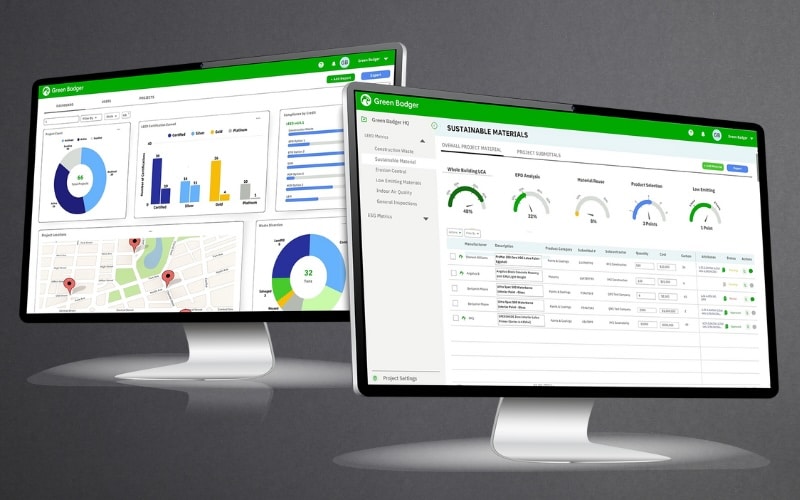
Green Badger’s new ESG software, showing the dashboard on the left and sustainable materials info on the right screen.
Linstroth explained that roughly two years ago, Green Badger expanded its focus beyond LEED so firms could benchmark and report ESG-related outcomes irrespective of certification paths. Increasingly, design and construction teams are being asked to deliver data for corporate social responsibility reports, internal carbon budgets, materials pledges, and public environmental disclosures. AEC professionals, he says, “are now being asked for sustainable development and construction and the reporting and certifications that go along with leadership in ESG,” necessitating tools that can keep pace with an explosion of metrics and accountability requirements.
The new Construction ESG platform addresses this by enabling organizations to track and benchmark everything from embodied carbon to M/WBE participation, from water use to workforce indicators, all within a unified cloud environment. For large enterprises, this allows project-level data to roll up seamlessly into corporate reporting structures. For smaller firms or mission-aligned organizations, the platform offers a level of visibility and structure typically accessible only to large sustainability departments. Whether the user is a Fortune 500 company or a regional design practice, the need for transparent, validated sustainability data has become universal.
Architects Push for Early-Stage Tools—and Green Badger Responds
One of the more unexpected drivers of the new update came from the architectural side of the industry. Architects had long used Green Badger’s LEED product database reactively—typically after materials were specified or procured. But over the past several years, more firms began asking for better tools to use the database proactively, particularly for material research aligned with the AIA Materials Pledge or early-stage embodied carbon decision-making.
Linstroth said many architects expressed the same sentiment: if the platform allowed more flexibility, they would use it at the beginning of the design process, not just at the certification phase. That feedback shaped a major expansion of the new platform. Green Badger now includes a fully revamped product research environment built specifically for architects, allowing teams to evaluate embodied carbon levels, access EPDs and HPDs, compare material options, and assemble firm-wide brand standards.
Whether the user is a Fortune 500 company or a regional design practice, the need for transparent, validated sustainability data has become universal.
Architects can now search tens of thousands of verified product entries and compare something as simple as two tile options for their embodied carbon impact. They can save preferred products for reuse, organize materials into firm standards, and ensure that early design moves align with sustainability commitments. According to Linstroth, these workflows can save firms “hundreds of hours” by consolidating material data that previously lived in disorganized spreadsheets or scattered repositories.
This shift reflects a larger industry trend: embodied carbon decision-making is moving upstream. Tools that once served compliance roles are now becoming foundational research companions at the design table.
A Vast and Verified Materials Database
Central to Green Badger’s platform is its vast materials database, which has evolved substantially over the years. Originally populated through internal curation and crowdsourced user input (with validation), it has now expanded through direct relationships with manufacturers, certification agencies, and major industry data sources.
With this update, Green Badger integrates directly with the two largest environmental product data ecosystems in the world:
- Building Transparency (EC3) for carbon data and tens of thousands of EPDs
- HPD Collaborative for health product declarations
This allows users to access environmental and health documentation directly from within Green Badger, complete with associated files such as EPDs, HPDs, VOC certifications, and CDPH documentation. The platform aggregates these sources, along with additional materials data, giving architects and contractors a centralized, verified repository rather than relying on scattered links or file-hunting.
Manufacturers cannot upload data directly—submissions must go through Green Badger’s internal validation process. This ensures the system maintains data integrity, an essential requirement if sustainability reporting is to mature from aspirational messaging into auditable evidence.
Dashboards Designed for Immediate Insight
A major visual change in the new release is the introduction of redesigned dashboard interfaces built on a modern tech stack. These dashboards use intuitive radial gauges—similar to automotive speedometers—to help teams understand progress instantly: LEED credit achievement, embodied carbon reductions, waste diversion, water and energy benchmarks, and M/WBE participation all surface visually and in real time.
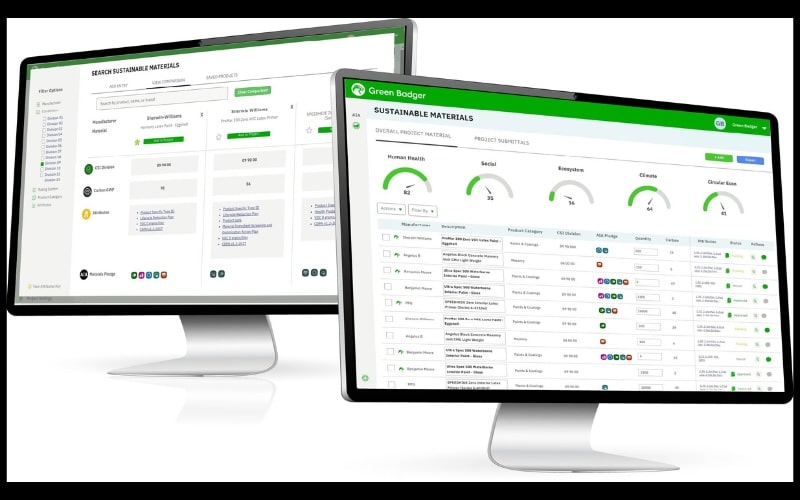
Another view of the new Green Badger software and its new user interface, all built on a modern web browser tech stack.
For many firms, this replaces workflows traditionally run through spreadsheets—systems that often obscure progress until it’s too late to course-correct. The new dashboards can be tailored to firm or project goals, offering a personalized cockpit that aligns with sustainability targets.
Teams can view projects by stage, certification path, or performance status. They can compare similar projects or zoom out to see patterns across entire portfolios. For owners managing multiple developments or architecture firms juggling dozens of concurrent efforts, the ability to glance at a dashboard and quickly diagnose performance is a marked improvement over reactive end-of-project reporting.
Rebuilding LEED Tracking for a Modern Era
While the ESG platform is the headline, the renewed LEED documentation tool is also a significant milestone. Originally developed during the LEED 2009 era, the previous software had reached the natural limits of its architecture. Instead of layering updates onto aging code, Green Badger rebuilt the LEED environment from scratch on top of its ESG foundation.
The result is a LEED tracking system ready for LEED v5 reporting. It supports cross-certification tracking beyond LEED itself, enables real-time collaboration across owners, GCs, subs, and consultants, and automates the generation of LEED submission packages, including ZIP archives of backup documents and auto-filled LEED worksheets.
Instead of layering updates onto aging code, Green Badger rebuilt the LEED environment from scratch on top of its ESG foundation.
Field reporting has also been enhanced on mobile iOS and Android apps, enabling site teams to complete IAQ inspections, erosion control reporting, and other required documentation directly on the jobsite. The platform maintains a time and user-stamped record for accountability, centralizing all documents within the project space.
Users report finding the vast majority of their materials inside Green Badger’s database, making the gathering of certification documentation far less arduous. Where custom or project-specific materials arise—such as custom millwork—teams can upload and track them manually with the same consistency.
A Centralized Future for AEC Sustainability Data
Green Badger’s latest platform is as much a reflection of industry evolution as it is a technical achievement. The building sector is transitioning into a phase where sustainability documentation is no longer isolated or optional. Firms are being called upon to prove environmental performance, demonstrate supply-chain responsibility, and deliver verifiable data across dozens of metrics.
Spreadsheets cannot scale to meet that challenge. What the industry now requires are centralized systems that validate, organize, and standardize sustainability information across disciplines, firms, and project lifecycles.
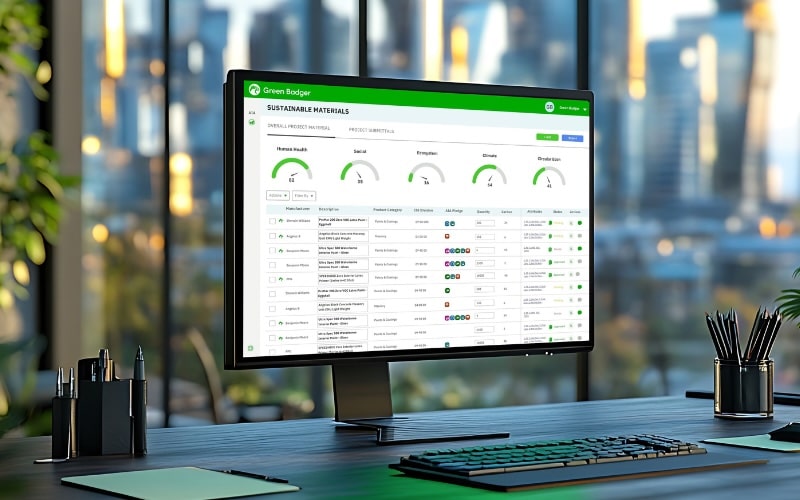
The new Green Badger is the industry’s preferred tool for ESG and LEED compliance management, and now with a very large and growing material research database that provides architects with the environmental and sustainable data they need to make material selections for their projects.
Green Badger appears to be aiming at exactly that role—a sustainability data backbone for AEC.
The platform’s combined ESG and LEED capabilities, architectural research tools, firm-wide standards workflows, integration with global environmental databases, and collaborative project environment all point to a future where sustainable construction data is continuous, transparent, and fully traceable.
The company’s decision to rebuild its tech stack signals confidence in where this market is heading. As Linstroth put it, “this platform is built on an ESG foundation and starts from the beginning—a ground-up reinvention shaped by new expectations, new regulations, and a rapidly maturing sustainability culture across the built environment.”
With embodied carbon commitments accelerating, LEED v5 in place, AIA materials pledges gaining traction, and owners demanding clearer sustainability reporting, this is a timely and meaningful advancement for AEC professionals.